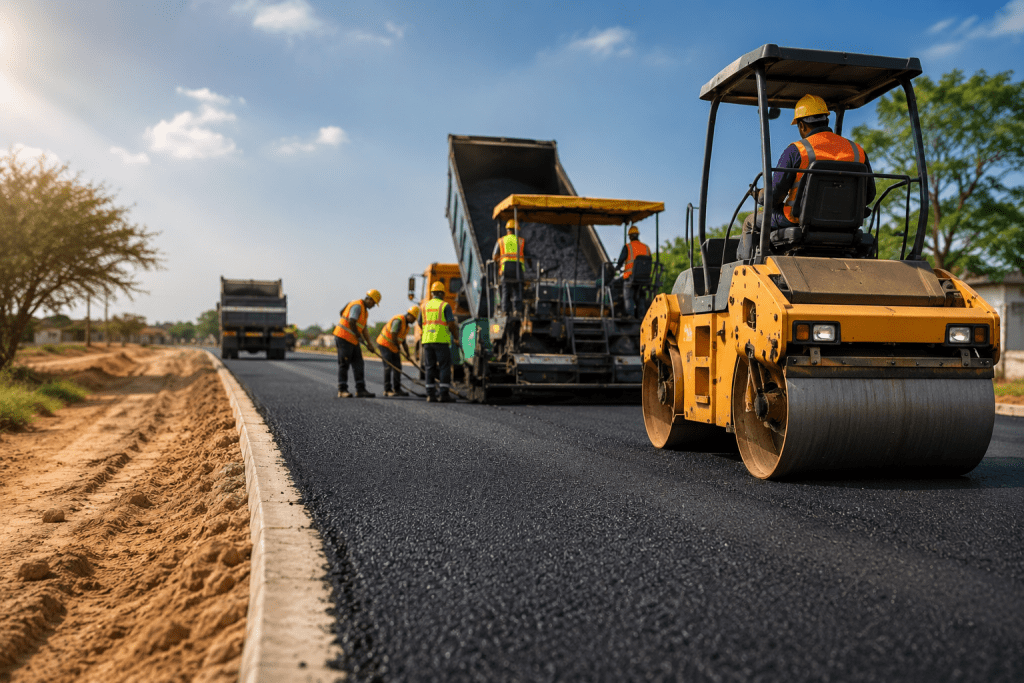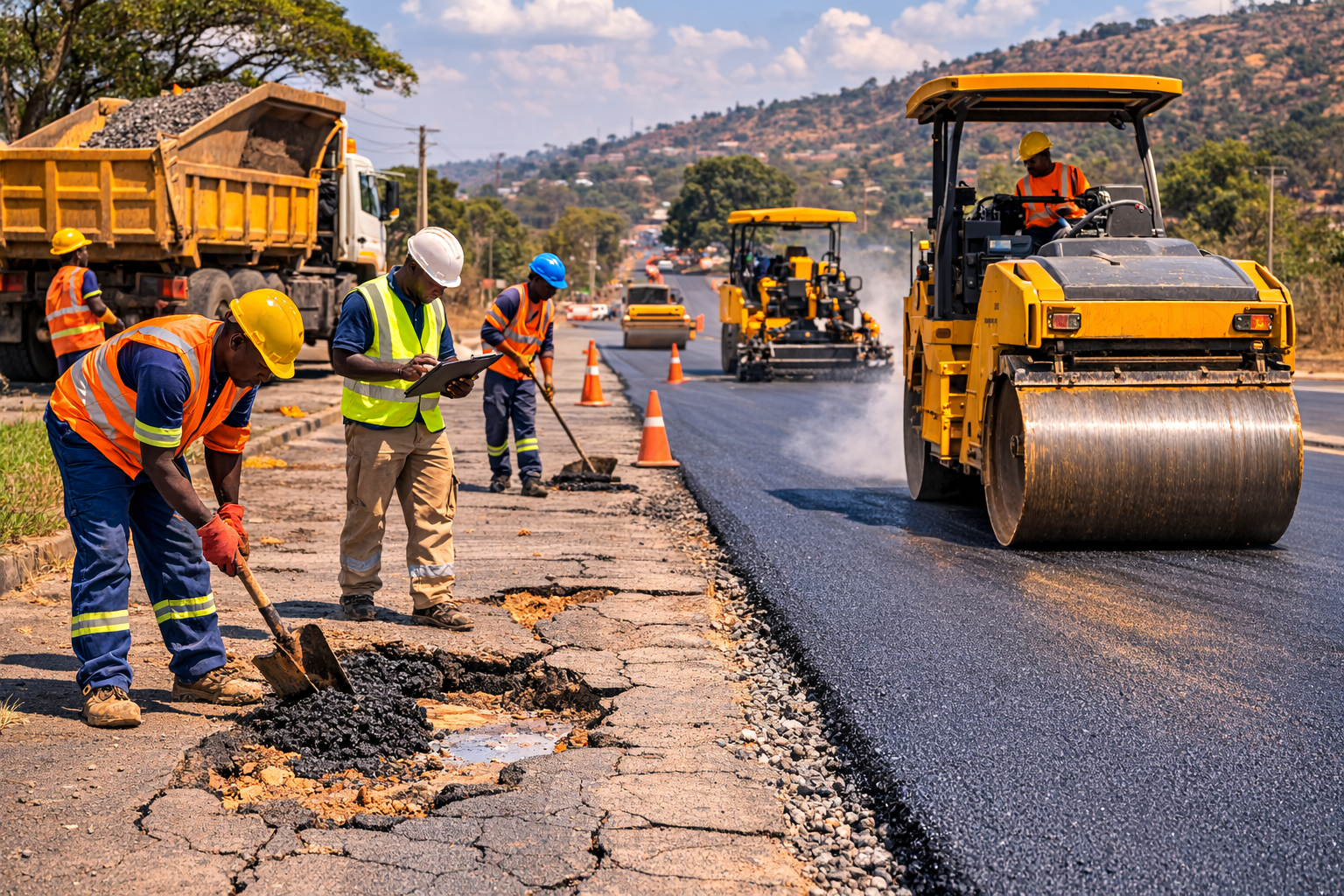
If you’re looking at a damaged road and wondering whether it needs a quick fix, resurfacing, rehabilitation, or a full rebuild, you’re asking the right question. In Zimbabwe, local contractors and public infrastructure documents do not treat these terms as the same thing.
They separate pothole patching and crack sealing from resurfacing, and they also distinguish rehabilitation from reconstruction as bigger, more structural interventions.
That matters because choosing the wrong scope is where a lot of money gets wasted. A road with surface wear only may not need full reconstruction, but a road with repeated potholes, drainage failure, weak base layers, and edge collapse is usually beyond a simple patching job.
Zimbabwe roadwork providers actively describe patching, crack sealing, resurfacing, rehabilitation, and reconstruction as different levels of work, which is exactly why the decision should be made properly at the start.
The short version
A simple way to think about it is this: road repair is usually the smallest intervention, resurfacing is the next step up, rehabilitation is more structural, and reconstruction is the biggest reset of the road.
So if the road is still structurally sound and the main problem is top-surface wear, resurfacing may be enough. If the road is failing from underneath, rehabilitation or reconstruction is usually the more honest conversation.
That is also consistent with local contractor wording around roads “in need of reconstruction” versus roads that can be rehabilitated, patched, or resurfaced.
Request a Road Assessment
Not sure whether your road needs repairs, resurfacing, rehabilitation, or reconstruction? Start with a practical site assessment based on real road condition.
What counts as road repair?
Road repair is usually the targeted, localised work done to keep a road trafficable without rebuilding major sections. In Zimbabwe, this includes things like pothole patching, crack sealing, edge patching, crocodile crack sealing, and slack repairs. Public road updates in Zimbabwe also refer to pothole patching and resurfacing as part of urban road maintenance activity.
That usually makes road repair the right option when the damage is limited to specific spots and the rest of the road structure is still in decent shape.
If you only have isolated potholes, some cracking, or early edge damage, targeted repairs can make sense. But if the same failures keep coming back in the same places, that is often a sign the road problem is deeper than a repair crew can solve with patching alone.
What is road resurfacing?
Resurfacing usually means restoring or replacing the worn upper layer of the road without fully rebuilding the entire pavement structure underneath.
Zimbabwe road contractors explicitly mention milling of old asphalt and resurfacing, while other Zimbabwe surfacing providers describe resurfacing old roads using asphalt, cold asphalt, bitumen emulsion, and related surfacing materials.
In practical terms, resurfacing is often the right move when the surface is tired, cracked, rough, or uneven, but the deeper road layers are still stable enough to carry the load. It is a bigger step than simple pothole repairs, but it is not the same as reconstructing the whole road.
If the road has become ugly, noisy, and high-maintenance on top, but has not completely failed underneath, resurfacing is often the middle-ground solution people should consider first.
What is road rehabilitation?
Road rehabilitation usually sits in the space between resurfacing and full reconstruction. Rehabilitation is used for roads that are more damaged than a resurfacing job but not automatically written off as full rebuilds from day one.
In plain language, rehabilitation usually makes sense when the road has structural distress, repeated potholes, drainage issues, edge failures, or weakened layers, but there is still a practical engineering path to restore it without completely rebuilding every part from scratch.
It is the “this road needs more than a cosmetic fix” option.
What is road reconstruction?
Reconstruction is the heavy end of the conversation. It usually means the road has deteriorated so badly that you are no longer talking about saving the existing structure with patching, sealing, or a new top layer alone.
Zimbabwe public documents repeatedly pair reconstruction with major rehabilitation, and Zimbabwe providers also list reconstruction separately from resurfacing, routine maintenance, and road rehabilitation.
If a road has widespread failure, major base problems, severe deformation, chronic drainage issues, and a structure that no longer matches the traffic load, reconstruction is often the more honest answer.
It is the expensive answer, but sometimes it is also the cheaper long-term answer compared with endlessly patching a road that has already failed structurally.
Request a Road Assessment
Not sure whether your road needs repairs, resurfacing, rehabilitation, or reconstruction? Start with a practical site assessment based on real road condition.
So how do you know which one your road needs?
A good starting point is to look at how widespread the problem is and where the damage is happening. If the surface is mostly intact and the issues are isolated, repairs may be enough.
If the top layer is worn but the road still feels structurally stable, resurfacing may make sense. If failures keep returning, edges are breaking down, drainage is clearly part of the problem, and the surface damage is really a symptom of deeper issues, you are usually moving into rehabilitation territory.
If the road has broadly lost structural integrity, reconstruction becomes more likely. This is practical judgment rather than a quoted rulebook, but it is grounded in the categories used by road authorities.
Another useful clue is whether the road is failing in the same places over and over again. Repeated potholes and repeated patch repairs often point to something bigger than surface wear.
Zimbabwe contractors emphasise patching, crack sealing, resurfacing, and rehabilitation as different stages for a reason. When the same defects keep returning, it usually means the intervention level has been too small for the actual condition of the road.
Why drainage changes the whole decision
One thing that comes up again and again in roadwork, even when it is not always shouted about in marketing copy, is drainage.
That matters because drainage problems can make a road look like it needs endless patching when the real problem is water weakening the structure. If water is getting into the road, sitting on the surface, or undermining the shoulders and edges, resurfacing alone may not last.
In those cases, rehabilitation or reconstruction decisions often need to include drainage correction as part of the scope.
Request a Road Assessment
Not sure whether your road needs repairs, resurfacing, rehabilitation, or reconstruction? Start with a practical site assessment based on real road condition.
Common real-world scenarios
If you have a road with a few isolated potholes and some cracks after the rainy season, you are probably looking at a repair conversation first. Zimbabwe city updates and contractors both reference pothole patching as a regular intervention for roads that are still basically functional.
If the road is largely intact underneath but the surface is tired, uneven, and wearing out across longer sections, resurfacing is often the more logical conversation. Zimbabwe surfacing providers explicitly market resurfacing as part of their roadwork services.
If the road has bigger recurring failures, edge damage, and visible distress that suggests the road layers are not holding up properly anymore, rehabilitation is the more realistic direction. Local contractor language supports this step-up from patching and resurfacing.
If large sections are badly broken down, the shape and structure are gone, and the road can no longer realistically perform without major rebuilding, reconstruction is the stronger candidate. Zimbabwe public documents and contractor categories support reconstruction as the most substantial intervention.
Final thought
The biggest mistake is not choosing repair, resurfacing, rehabilitation, or reconstruction. The biggest mistake is choosing a scope that is too small for the actual problem.
Zimbabwe roadwork language already tells us these are different types of work, not interchangeable labels. So the smartest move is to assess the real condition of the road, be honest about whether the damage is surface-level or structural, and then choose the intervention that matches reality.
If you get that decision right, you stop spending like someone who is constantly reacting, and start spending like someone who is fixing the road properly.
Request a Road Assessment
Not sure whether your road needs repairs, resurfacing, rehabilitation, or reconstruction? Start with a practical site assessment based on real road condition.
Frequently Asked Questions
What is the difference between road repair and road rehabilitation?
Road repair is usually localised work such as pothole patching, crack sealing, or edge repairs, while rehabilitation is a bigger intervention used when the road condition goes beyond surface defects and needs more structural attention.
Is road resurfacing the same as reconstruction?
No. Resurfacing usually deals with the upper road layer, while reconstruction is treated as a larger intervention in Zimbabwe public and contractor road language.
When is pothole patching not enough?
When potholes keep returning, damage is widespread, or the road shows deeper structural distress, patching is often too small a response.
Does a badly drained road usually need more than resurfacing?
Often yes. Zimbabwe contractors link roads with stormwater drainage and wider civil works, which suggests drainage issues can be part of why roads keep failing.
What does reconstruction usually involve?
Zimbabwe sources do not lay out one universal definition, but they consistently treat reconstruction as a more substantial intervention than routine maintenance, pothole repair, resurfacing, or ordinary rehabilitation.
How do I know which scope my project needs?
The most practical starting point is an assessment of the road condition, including how widespread the failure is, whether the damage is mainly surface-level or structural, and whether drainage is part of the problem.
Request a Road Assessment
Not sure whether your road needs repairs, resurfacing, rehabilitation, or reconstruction? Start with a practical site assessment based on real road condition.