Mineral exploration projects depend heavily on accurate geological information. Before significant investment is made in mining development, exploration companies need reliable data about mineral deposits, rock formations, ore grades, and underground conditions. This information helps determine whether a project is commercially viable and worth pursuing further.
Two of the most widely used exploration drilling methods in Zimbabwe are diamond core drilling and reverse circulation drilling, commonly known as RC drilling. Both methods are used extensively throughout the mining sector for gold, lithium, chrome, nickel, platinum, copper, and other mineral exploration projects.
Although both drilling techniques serve the same overall purpose, they provide different types of information and are suited to different stages of exploration. Choosing the wrong drilling method can increase project costs, delay decision-making, and reduce the quality of geological data available to the exploration team.
Understanding the difference between diamond core drilling and RC drilling helps mining companies, investors, and exploration managers select the most suitable approach for their project objectives.
Request Exploration Drilling Services
Need professional drilling services for a mining or exploration project in Zimbabwe? Contact our team to discuss your exploration requirements.
What Is Diamond Core Drilling?
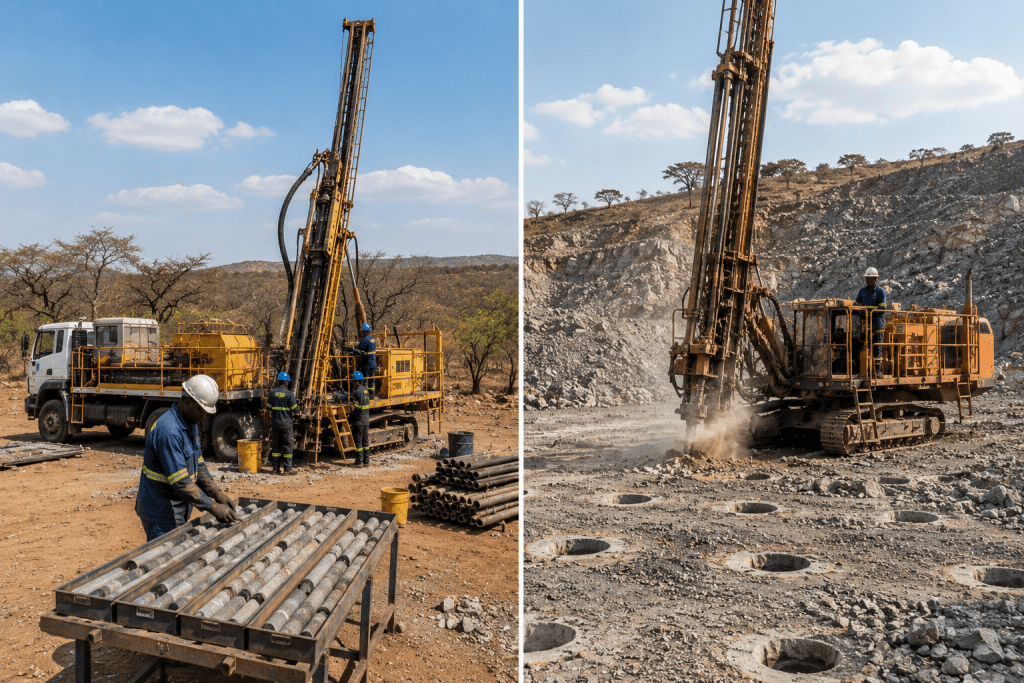
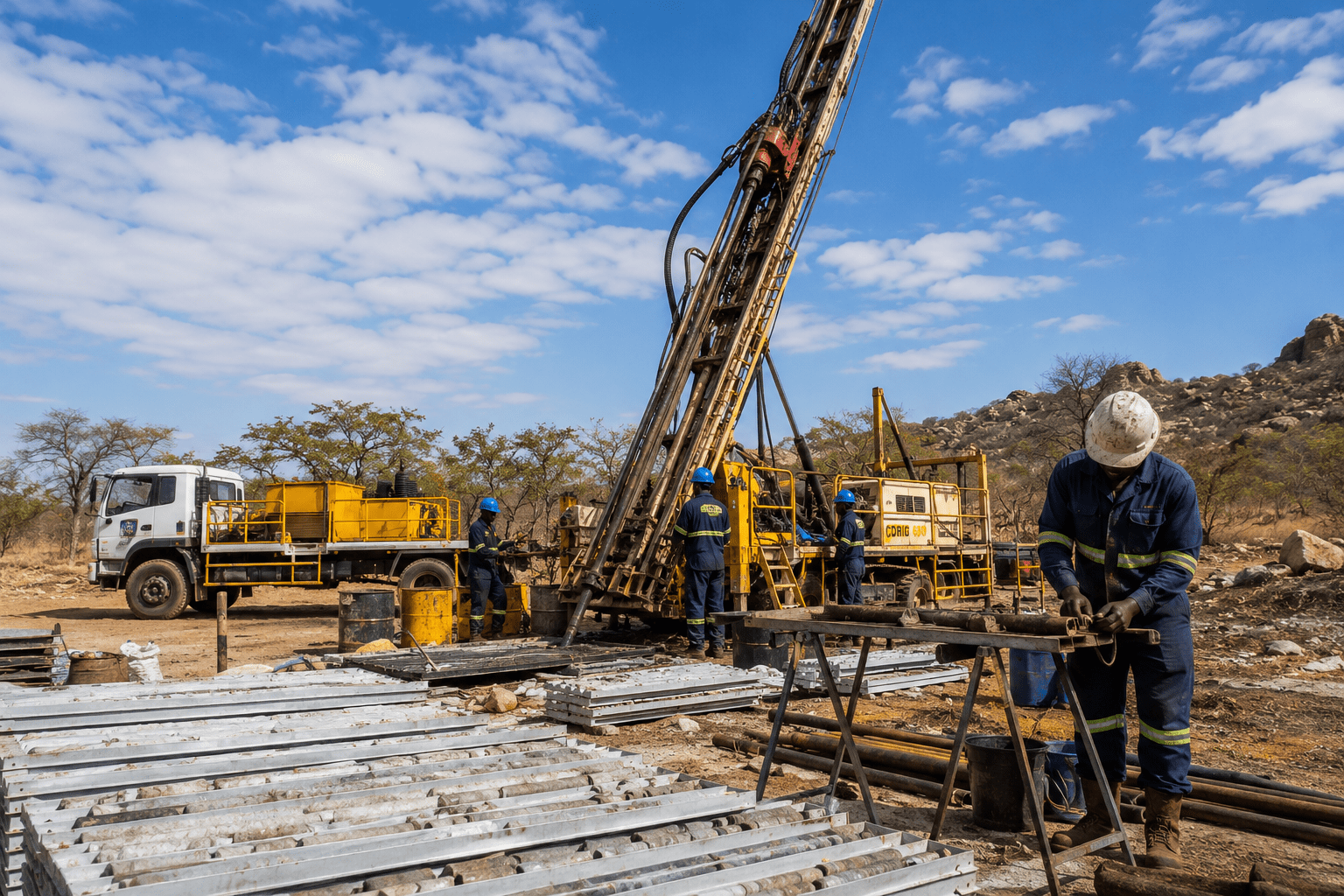
Diamond core drilling is an exploration method that uses a rotating drill bit embedded with industrial diamonds to cut through rock formations and recover a continuous cylindrical sample known as a core.
The recovered core provides a physical representation of the underground geology. Geologists can examine the sample directly to study rock structures, mineralisation, fault zones, fractures, and other geological features that may influence the value of a mineral deposit.
One of the biggest advantages of diamond core drilling is the quality of information it provides. Because the core remains largely intact when extracted, geologists can observe geological characteristics that would otherwise be difficult to identify through other drilling methods.
Diamond core drilling is commonly used during advanced exploration programmes where detailed geological analysis is required. Mining companies often rely on this method when calculating mineral resources, estimating reserves, or conducting feasibility studies before mine development begins.
The process is generally slower than RC drilling because the core must be cut, extracted, and handled carefully to preserve sample quality. However, the additional information obtained from the core often justifies the higher cost.
In Zimbabwe, diamond core drilling is widely used for gold exploration, lithium projects, base metal exploration, and geological investigations requiring highly accurate subsurface data.
What Is RC Drilling?
Reverse circulation drilling, commonly referred to as RC drilling, uses compressed air to force rock chips from the drill hole to the surface. Instead of recovering a solid core sample, RC drilling produces rock cuttings that can be collected and analysed for mineral content.
The drilling process uses dual-wall drill rods that allow samples to travel directly from the bottom of the hole to the surface through an internal tube. This reduces contamination and improves sample quality compared to some other drilling methods.
RC drilling is generally much faster than diamond core drilling. Because the system is designed to produce samples quickly, large areas can be tested efficiently within shorter timeframes.
For this reason, RC drilling is often used during early-stage exploration programmes where the primary objective is to identify mineralised zones and evaluate the potential of a prospect.
Mining companies frequently use RC drilling to define targets before moving to more detailed diamond drilling programmes. The method provides reliable grade information while allowing exploration teams to cover more ground at a lower cost.
In Zimbabwe, RC drilling is commonly used for gold exploration, lithium exploration, and resource definition programmes where speed and cost efficiency are important considerations.
Diamond Core vs RC Drilling: Understanding the Key Differences
Although both drilling methods are used for mineral exploration, they provide different types of information and serve different exploration objectives.
The most significant difference lies in the type of sample recovered. Diamond drilling produces an intact rock core, while RC drilling produces rock chips and cuttings. This distinction has a major impact on the level of geological information available for analysis.
With diamond core drilling, geologists can study rock structures in detail. Features such as fractures, fault zones, alteration patterns, and mineral textures remain visible within the core sample. This information is critical when developing geological models and estimating mineral resources.
RC drilling focuses primarily on obtaining representative samples for grade analysis. While it provides valuable information about mineral content, it does not offer the same level of geological detail as diamond core drilling.
Another major difference is drilling speed. RC drilling is generally much faster, allowing exploration teams to complete more metres in less time. This makes it particularly attractive during regional exploration programmes where large areas need to be assessed efficiently.
Diamond drilling is slower because the core must be cut and recovered carefully. However, the trade-off is significantly higher-quality geological information.
Cost is another important consideration. Diamond drilling usually costs more per metre than RC drilling because of the specialised equipment, drilling consumables, and additional handling requirements involved.
Which Drilling Method Is More Cost Effective?
Cost effectiveness depends largely on the objectives of the exploration programme rather than the drilling method itself.
For early-stage exploration, RC drilling is often considered more cost effective because it allows exploration teams to test large target areas quickly. Companies can gather substantial amounts of data without committing to the higher costs associated with diamond drilling.
In Zimbabwe, RC drilling costs can vary significantly depending on geology, access conditions, drilling depth, and project location. However, RC drilling is generally less expensive per metre than diamond core drilling.
Diamond drilling involves higher operational costs because the process is slower and requires specialised consumables such as diamond drill bits and core barrels. Additional handling, logging, and storage of core samples also contribute to overall project expenses.
Despite these higher costs, diamond drilling often becomes the more economical choice during advanced exploration stages because of the quality of information obtained. Accurate geological data reduces uncertainty and helps companies make more informed investment decisions.
Many successful exploration programmes actually use both methods. RC drilling may be used initially to identify promising targets, followed by diamond drilling to obtain detailed geological information from priority areas.
Which Method Produces Better Geological Data?
When geological detail is the priority, diamond core drilling is widely regarded as the superior option.
The continuous core sample provides direct visual evidence of underground conditions. Geologists can analyse rock structures, identify mineralisation patterns, measure geological contacts, and understand the controls influencing mineral deposits.
This information is essential when developing resource models, estimating reserves, and planning future mine development.
RC drilling provides reliable geochemical data and grade information, but it does not preserve the same level of geological detail. Important structural features may be difficult or impossible to interpret accurately from rock chips alone.
For this reason, many mining companies use diamond drilling during resource definition and feasibility stages where confidence in the geological model becomes increasingly important.
The choice ultimately depends on the exploration objectives and the level of geological understanding required at a particular stage of the project.
Request Exploration Drilling Services
Need professional drilling services for a mining or exploration project in Zimbabwe? Contact our team to discuss your exploration requirements.
When Should You Use Diamond Core Drilling?
Diamond core drilling is typically used when detailed geological information is required to support decision-making.
Projects approaching resource estimation, reserve calculation, feasibility studies, or mine development often rely heavily on diamond drilling because of the quality of information obtained.
The method is also valuable when geological structures play a significant role in mineral distribution. Understanding faults, fractures, veins, and alteration zones can be critical when evaluating the economic potential of a deposit.
Diamond drilling may also be preferred when exploration targets occur at greater depths or when highly accurate geological records are required for regulatory or reporting purposes.
Although the method is more expensive, the quality of data often provides significant value during advanced exploration programmes.
When Should You Use RC Drilling?
RC drilling is particularly effective during the early and intermediate stages of mineral exploration.
Companies often use RC drilling to evaluate new prospects, define mineralised zones, and gather grade information across large target areas. The speed of the method allows exploration teams to test multiple targets efficiently without incurring the higher costs associated with diamond drilling.
RC drilling is also useful when the primary objective is sample collection for laboratory analysis rather than detailed structural interpretation.
For many exploration programmes in Zimbabwe, RC drilling provides an excellent balance between cost, speed, and data quality during the initial phases of project development.
Once promising zones have been identified, diamond drilling can then be used to obtain more detailed geological information.
Exploration Drilling Services in Zimbabwe
Zimbabwe remains one of Africa’s most active mineral exploration destinations, with ongoing exploration activities focused on gold, lithium, platinum group metals, chrome, nickel, copper, and rare earth minerals.
Exploration drilling projects are conducted across major mining regions including Mashonaland, Midlands, Matabeleland, Manicaland, and other mineral-rich areas throughout the country.
Successful exploration programmes depend on selecting the right drilling method for each stage of the project. Whether the objective is rapid target generation, resource definition, or advanced geological modelling, choosing the appropriate drilling technique can significantly influence project outcomes.
Final Thoughts
Diamond core drilling and RC drilling both play important roles in mineral exploration across Zimbabwe. While RC drilling offers speed and cost efficiency for early-stage exploration, diamond core drilling provides the detailed geological information required for advanced project evaluation and resource development.
Neither method is universally better than the other. The right choice depends on the objectives of the exploration programme, the level of geological detail required, and the stage of project development.
Many of the most successful exploration projects use both methods strategically. RC drilling helps identify and define targets efficiently, while diamond drilling provides the detailed geological understanding needed to support long-term investment decisions.
By selecting the appropriate drilling method at the right stage of exploration, mining companies can improve decision-making, reduce uncertainty, and maximise the value of their exploration programmes.
Discuss Your Exploration Project
Whether you require diamond core drilling, RC drilling, or a combination of both, our team can help identify the most suitable approach for your exploration programme.