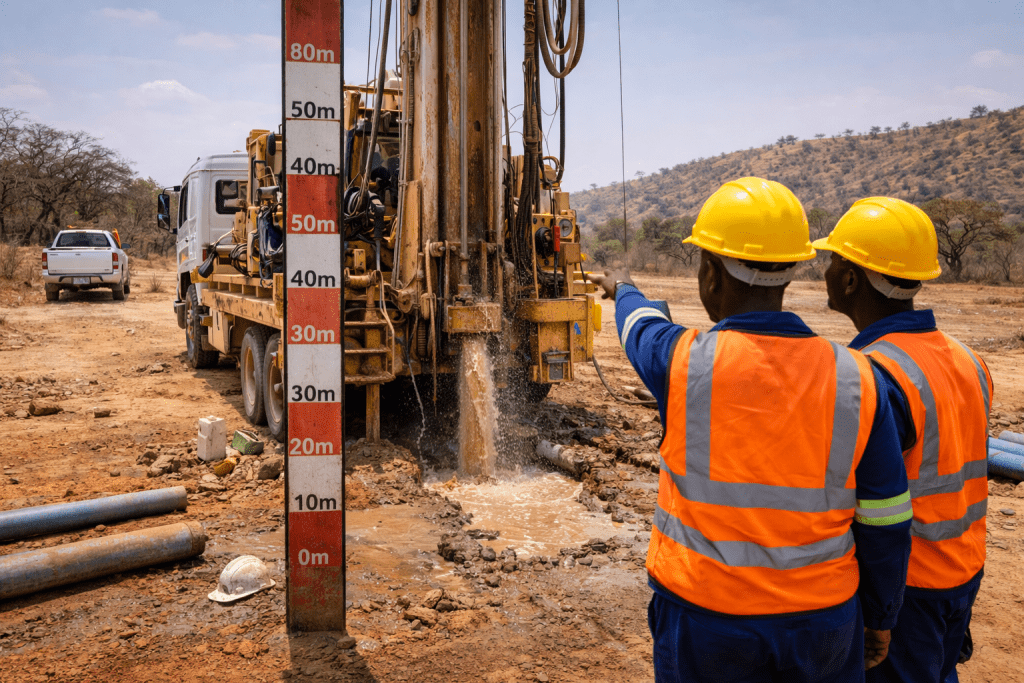
If you are planning a borehole, one of the smartest things you can do before drilling starts is make sure you are drilling in the right place. That may sound obvious, but a lot of people still treat borehole placement like a quick guess, a neighbour’s suggestion, or a matter of convenience.
The problem is that a borehole is not only about drilling a hole into the ground. It is about drilling in a position that gives you the best chance of finding usable, reliable water at a practical depth and with a yield that makes sense for your property.
That is why borehole siting matters so much. If the drilling point is chosen badly, the project can become more expensive than it needed to be from the very beginning.
You may end up drilling deeper than expected, getting poor yield, spending more on extra metres, or paying for a borehole that never performs the way you hoped. A proper siting process helps reduce that risk and gives the drilling work a much stronger starting point.
Borehole Siting Enquiry
Tell us where your property is and what the borehole is for, and get the next step for water survey, siting, and planning.
What borehole siting actually means
Borehole siting is the process of identifying the best place to drill on a property based on underground conditions rather than guesswork. In practical terms, it is about trying to understand where water-bearing zones are most likely to be, what kind of depth may be needed, and which drilling point gives you the best balance between water potential and practical use on the property.
It also helps answer the questions people usually have before they commit to drilling. Where should the borehole go? How deep is it likely to be? Is the point suitable for household use, irrigation, commercial use, or a larger facility? Is one side of the property a better option than another?
A good siting process gives you a more informed answer before the rig arrives.
Why guesswork usually ends up costing more
The biggest problem with guesswork is that it feels cheaper at the beginning and more expensive later. Skipping siting can seem like a way to save money upfront, but if the drilling point is poor, that “saving” can disappear very quickly.
You could end up drilling deeper than expected because the chosen point is weak. You could end up with poor water yield and need to rethink the setup later. You could spend money on a borehole that works on paper but does not really meet the water needs of the property. And in some cases, you may end up drilling again or paying for additional work that could have been avoided with better planning from the start.
That is why borehole siting should not be seen as an unnecessary extra. It is part of making a better drilling decision.
Why copying your neighbour is not a proper siting strategy
This is one of the most common shortcuts people take. A neighbour drills in one spot, gets water, and suddenly that point becomes the “correct” answer for everyone nearby.
The problem is that underground conditions do not follow stand boundaries neatly. Two properties next to each other can still have different results. One may have a better fracture zone, a more productive water-bearing layer, or more suitable drilling conditions than the other. So while nearby successful boreholes can be encouraging, they should only be treated as a clue, not a guaranteed answer.
It is always better to work from what the actual ground conditions on your property suggest rather than assuming the same result will simply repeat next door.
Borehole Siting Enquiry
Tell us where your property is and what the borehole is for, and get the next step for water survey, siting, and planning.
A geological survey for a borehole gives you a better starting point
When people talk about a geological survey for a borehole, what they usually want is confidence before spending money on drilling. They want to know that the drilling point is not being chosen randomly and that the likely depth and yield have at least been thought through properly.
A survey helps give that direction. It can point to the most promising drilling area, help estimate expected depth, and make the overall drilling plan more realistic. It does not remove every uncertainty, because boreholes still depend on what is actually found in the ground, but it puts the project on a much stronger footing than guessing.
That is especially important when the borehole is meant to serve a real purpose, not just exist. A home with regular water use, a farm, a school, a clinic, staff accommodation, irrigation, or a business property all need a drilling point chosen with practical water demand in mind.
Where to drill a borehole on your property
The best place to drill is not always the most convenient-looking spot.
Sometimes people want the borehole close to the house, close to the driveway, or tucked into a neat corner where it feels least disruptive. But the best drilling point should first make sense underground, then practically on the property.
That means the right location should balance likely water potential with usability. It should work for the intended water system, be practical for installation and maintenance, and still give the drilling team a sensible point to work from. On some properties, the most convenient spot and the most promising spot may be the same. On others, they may not be.
That is exactly why borehole siting matters. It helps avoid making a property decision based only on convenience when the real priority should be long-term water performance.
Borehole Siting Enquiry
Tell us where your property is and what the borehole is for, and get the next step for water survey, siting, and planning.
Does borehole siting guarantee water?
No honest process should be sold that way.
Siting improves the quality of the decision. It helps reduce guesswork, improves planning, and increases the chances of choosing a stronger drilling point. But a borehole is still drilled into real ground, and real ground can still surprise you.
The value of siting is not that it guarantees a perfect result. The value is that it helps you make a smarter, more informed, less risky decision before the expensive part begins.
That is a big difference.
Borehole survey cost in Zimbabwe
If you are trying to budget properly, it helps to include the cost of siting upfront instead of treating it like an optional extra. In many cases, borehole siting in Zimbabwe can start from around US$80 in Harare, and a practical range for many properties is often around US$80 to US$200, depending on location, travel, and site conditions.
In some areas, you may also see siting priced around US$150. Even though that adds something to the budget at the start, it is usually small compared with the total cost of drilling, casing, pump installation, tanks, and the rest of the system — and it can save you from making a much more expensive mistake later.
Why siting matters even more when budgets are tight
Ironically, siting becomes even more important when money is limited. When budgets are tight, there is even less room for error. A badly chosen drilling point can turn a carefully planned project into a frustrating and expensive one.
If you are trying to control borehole costs, one of the best ways to do that is not to skip siting. It is to make the drilling decision more accurate. A more accurate starting point helps with budgeting, helps with depth expectations, and gives you a better sense of what the project is likely to involve before major costs begin.
What a good siting process should help you understand
A useful siting process should leave you with more clarity than you had before. You should come away with a better idea of where the borehole should go, what kind of depth may be expected, and whether the point suits the water needs of the property.
It should also help you ask better questions before drilling starts. If the expected depth is deeper than you thought, you can plan for that. If one part of the property is more promising than another, you can make the right trade-off early instead of regretting it later. If the expected yield may only suit light domestic use, that matters too.
Good siting is not about sounding technical. It is about helping you make a better drilling decision.
Final thought
If you are serious about drilling a borehole, the cheapest shortcut is not always the cheapest outcome. Choosing where to drill based on guesswork, convenience, or neighbour assumptions can cost more later in extra depth, poor yield, disappointing performance, or wasted drilling spend.
A better approach is to start with the right question: where should this borehole actually go?
That one step can make the rest of the project far more practical, far more predictable, and far more likely to give you a borehole that is worth the money you put into it.
Borehole Siting Enquiry
Tell us where your property is and what the borehole is for, and get the next step for water survey, siting, and planning.
Frequently Asked Questions
What is borehole siting?
Borehole siting is the process of identifying the best place to drill a borehole based on underground conditions rather than guesswork. It helps improve the chances of drilling in a more suitable position for water yield and long-term use.
Why is a geological survey for a borehole important?
A geological survey helps you make a more informed drilling decision. It can help identify a stronger drilling point, give a more realistic idea of likely depth, and reduce the risk of drilling in the wrong place.
Where should I drill a borehole on my property?
The best place to drill should be based on likely underground water conditions first, then practical property use second. The most convenient-looking spot is not always the best drilling point.
Can I just use the same borehole position as my neighbour?
You can use nearby boreholes as a rough clue, but they should not be treated as a guaranteed answer. Two neighbouring properties can still produce different results.
Is borehole siting worth the extra cost?
In most cases, yes. The cost of siting is usually small compared with the cost of drilling in the wrong place or ending up with a poor-performing borehole.
Does a borehole survey guarantee water?
No. It improves the quality of the decision and reduces guesswork, but it does not guarantee the final result. The main benefit is making the drilling plan much more informed.
What affects borehole survey cost in Zimbabwe?
Survey cost can vary depending on your location, travel distance, site conditions, and the type of property. The exact amount differs from one project to another.
Borehole Siting Enquiry
Tell us where your property is and what the borehole is for, and get the next step for water survey, siting, and planning.