If you are planning a borehole, one of the first questions that comes up is simple: how deep should it be? It sounds like it should have a straightforward answer, but it usually doesn’t.
Borehole depth in Zimbabwe depends on the geology of the site, the water-bearing zones below the ground, the intended water use, and whether the drilling point was chosen properly in the first place. That is why two properties in the same general area can still end up with different drilling depths.
The short answer
A practical starting point is this: many borehole quotations in Zimbabwe are built around 40 metres, but a lot of successful boreholes end up somewhere in the 40 to 100 metre range depending on the site.
In some areas, productive boreholes are drilled deeper than that, and in others, usable water may be found earlier. The right depth is the one that gives you a reliable supply for the property, not just the one that sounds cheapest at the beginning.
Request a Borehole Quote
Planning a borehole in Zimbabwe? Submit your details for a practical response based on your site and expected water demand.
Why there is no single “correct” depth
The biggest mistake is assuming every property needs the same depth. Boreholes are not drilled to a fixed national number. They are drilled to reach usable water-bearing zones, and those zones do not sit at the same depth everywhere.
A site with favourable conditions may produce a good result at a shallower depth. Another site may need much more drilling because the productive fractures or aquifer zones are deeper, weaker, or more difficult to reach. That is why the question should never be “What depth do most people use?” on its own. It should be “What depth makes sense for this site?”
Why 40 metres keeps coming up
If you have looked at borehole pricing in Zimbabwe, you have probably noticed that 40 metres appears again and again. That is because many drilling companies use it as a standard base depth for quoting. It gives people a starting point for budgeting, and it often works as a minimum practical benchmark for drilling packages.
But that does not mean 40 metres is always enough. It only means it is a common pricing base. If the ground conditions on your site suggest that reliable water lies deeper, then the final borehole depth may need to go beyond that base package.
Why the water table does not tell the whole story
A lot of people assume that if water sits relatively shallow underground, the borehole should also be shallow. In reality, a working borehole is often drilled deeper than the water table itself because the goal is not just to touch water — it is to reach a more reliable, productive water-bearing zone.
In Zimbabwe, groundwater references note that water tables are often less than 15 metres deep, while many boreholes are still drilled to around 70 to 100 metres. That difference is one of the clearest signs that borehole depth is about more than simply “finding water.” It is about finding a supply that is more dependable and more useful over time.
Request a Borehole Quote
Planning a borehole in Zimbabwe? Submit your details for a practical response based on your site and expected water demand.
Why some boreholes need to go deeper
There are a few main reasons a borehole may need more depth.
The first is geology. Some rock formations hold water better than others. Some properties have productive fractures closer to the surface, while others require deeper drilling to reach a stronger water-bearing zone.
The second is yield. A shallow water strike is not always enough. If the water-bearing zone is weak, seasonal, or not strong enough for the property’s needs, drilling may continue to reach a better-producing level.
The third is intended use. A light domestic setup does not have the same water demand as irrigation, a farm, staff accommodation, a clinic, a school, or a business premises. The depth decision should match the kind of supply you actually need.
Does deeper always mean better?
Not automatically.
A deeper borehole is only better if it improves the long-term usefulness of the water supply. Drilling deeper without a good reason can simply increase cost. The goal is not to chase the biggest number. The goal is to drill to a depth that makes the borehole practical, reliable, and worth the money you are putting into it.
So the better question is not “How deep can we go?” It is “How deep do we need to go to give this property a stronger chance of reliable supply?”
Why siting matters before anyone talks about final depth
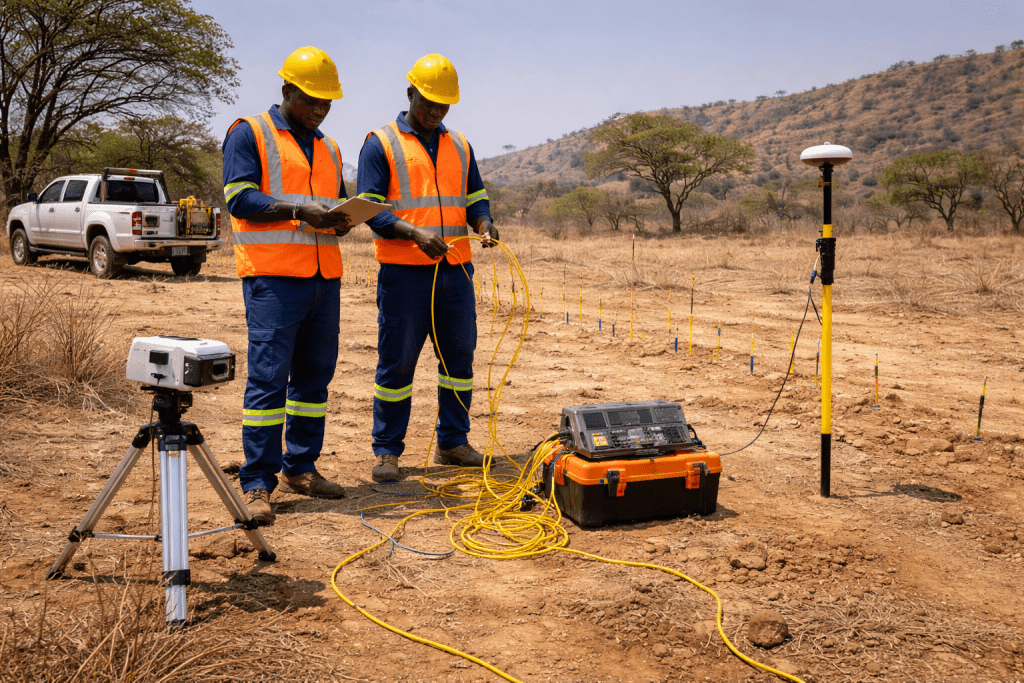
This is where borehole siting becomes so important. A proper survey helps identify the most promising drilling point and gives a more realistic idea of the likely depth before major drilling costs begin.
Without siting, depth becomes more of a gamble. You may still get water, but you are making a much bigger guess about where to drill, how deep to budget for, and whether the final yield will be good enough. With better siting, the drilling decision becomes more informed from the start.
That is one reason it is risky to rely only on what happened next door. A neighbour may have struck water at 45 metres, but that does not guarantee the same result on your stand.
Request a Borehole Quote
Planning a borehole in Zimbabwe? Submit your details for a practical response based on your site and expected water demand.
What is a realistic depth range to keep in mind?
If you are just trying to budget and think ahead, a useful way to look at it is this:
Many Zimbabwe borehole projects start with 40 metres as the quoting base, and a lot of real-world drilling ends up somewhere in the 40 to 100 metre range. In some hydrogeological settings, boreholes commonly fall in the 70 to 100 metre range even where groundwater is encountered much shallower. There are also cases where productive boreholes are deeper, especially in tougher formations or lower-yield areas.
That range is useful for planning, but it should still be treated as a guide, not a promise.
Can a borehole be too shallow?
Yes.
A borehole can hit water and still not perform well enough for long-term use. If it is stopped too early, the yield may be weak, seasonal, or not enough for the actual needs of the property. That is why stopping at the first sign of water is not always the smartest approach. A more useful borehole is one that has been drilled to a depth that supports a stable and practical supply.
Can a borehole be deepened later?
Sometimes, but that is usually not the best way to plan.
Deepening later can add extra cost, extra delay, and extra uncertainty. It is generally better to get the siting right first and approach the drilling depth properly from the start than to treat deepening as the backup plan.
Request a Borehole Quote
Planning a borehole in Zimbabwe? Submit your details for a practical response based on your site and expected water demand.
Final thought
If you are asking how deep should a borehole be in Zimbabwe, the most honest answer is this: there is no single fixed depth that suits every property. A lot of projects start from around 40 metres for budgeting, but many boreholes end up in the 40 to 100 metre range, and some go deeper depending on geology, yield, and water demand.
So instead of chasing a random number, focus on the outcome you actually need: a borehole drilled in the right place, to the right depth, with the best chance of giving you reliable water for the long term.
Frequently Asked Questions
What is the average borehole depth in Zimbabwe?
A lot of boreholes in Zimbabwe are discussed within a 40 to 100 metre range, although some are shallower and others go deeper depending on the site.
Is 40 metres deep enough for a borehole in Zimbabwe?
Sometimes, yes. But 40 metres is better treated as a common quoting base than a guaranteed final depth. Many sites need more depth for a stronger and more reliable supply.
Does the water table tell you how deep to drill?
Not by itself. Water may be encountered at a shallower level, but boreholes are often drilled deeper to reach more productive and dependable water-bearing zones.
Is a deeper borehole always better?
No. A deeper borehole is only better if it improves yield and reliability. Drilling deeper without a good reason can just increase the cost.
Can two neighbouring properties need different borehole depths?
Yes. Nearby properties can still have different underground conditions and different drilling results.
Should I do siting before drilling?
Yes. Siting helps identify a better drilling point and gives a more realistic idea of likely depth before drilling starts.
Request a Borehole Quote
Planning a borehole in Zimbabwe? Submit your details for a practical response based on your site and expected water demand.