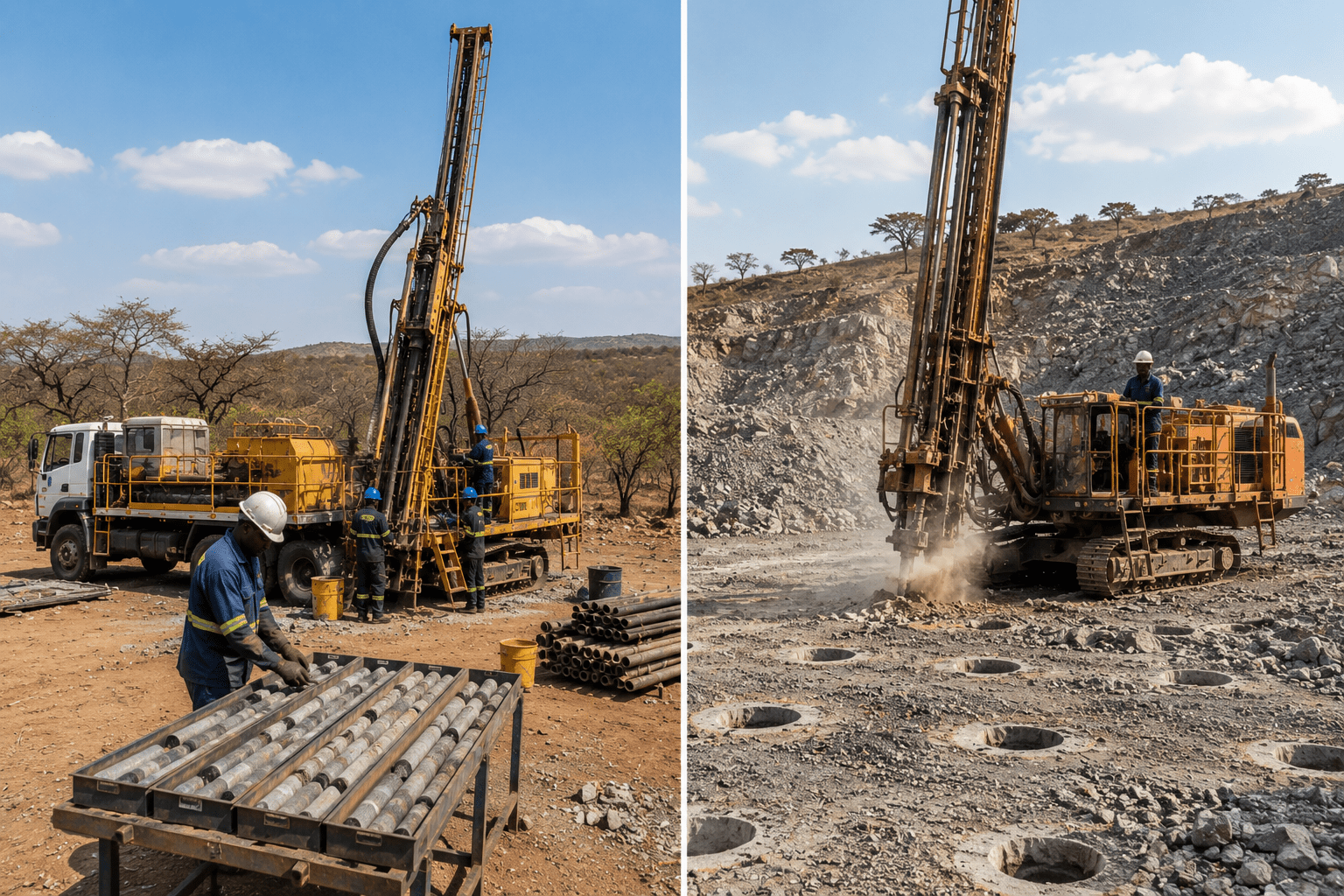
Drilling plays a critical role throughout the mining industry, but not all drilling methods serve the same purpose. Two techniques that are often confused are reverse circulation drilling, commonly known as RC drilling, and blast hole drilling. While both involve drilling into the ground using specialised equipment, they are designed for completely different objectives.
In Zimbabwe’s mining sector, RC drilling is widely used during mineral exploration programmes to collect geological information and identify economically viable mineral deposits. Blast hole drilling, on the other hand, is primarily used during active mining operations to prepare rock for blasting and excavation.
Understanding the difference between RC drilling and blast hole drilling helps mining companies, project managers, investors, and exploration teams select the right drilling method for each stage of a mining project. Choosing the wrong approach can result in unnecessary costs, delays, and operational inefficiencies.
Although both methods are important within the mining industry, they contribute to different phases of the mining lifecycle and provide different outcomes.
Request Professional Drilling Services
Need reliable drilling services for a mining or exploration project in Zimbabwe? Contact our team to discuss your project requirements.
What Is RC Drilling?
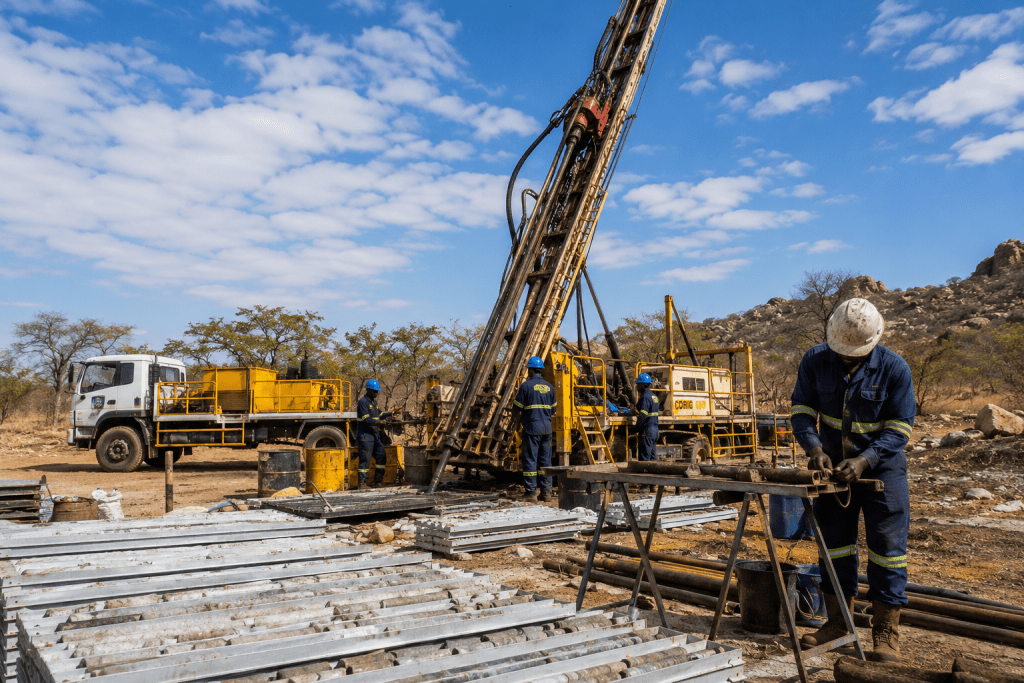
Reverse circulation drilling is an exploration drilling method used to collect underground samples for geological analysis. The process uses a specialised drill rig and dual-wall drill rods that transport rock chips from the bottom of the hole to the surface using compressed air.
The recovered samples are collected and analysed to determine the presence, quality, and distribution of minerals beneath the surface. This information helps geologists and mining companies evaluate the economic potential of a prospect before significant investment is made.
RC drilling is popular throughout Zimbabwe because it provides reliable geological information while remaining faster and more cost-effective than some other exploration methods. It is commonly used during gold, lithium, chrome, nickel, platinum, and copper exploration programmes.
One of the biggest advantages of RC drilling is its ability to produce relatively uncontaminated samples from significant depths. This allows exploration teams to obtain accurate grade information while covering large target areas efficiently.
Because RC drilling is designed specifically for exploration, the focus is on collecting data rather than preparing rock for extraction.
What Is Blast Hole Drilling?
Blast hole drilling serves a completely different purpose. Rather than collecting samples for geological analysis, blast hole drilling is used to create holes that will later be filled with explosives.
These explosives are detonated to fracture and break large volumes of rock, making it easier to remove material during mining operations. Blast hole drilling is therefore a production-focused activity rather than an exploration activity.
Once a mineral deposit has been identified and mining operations begin, blast hole drilling becomes a critical part of the extraction process. The drilling pattern, hole depth, spacing, and explosive loading all influence the effectiveness of the blast and the efficiency of the mining operation.
In Zimbabwe, blast hole drilling is commonly used in open-pit mines, quarries, aggregate operations, and large-scale mining projects where rock fragmentation is required before excavation.
The primary goal is not to gather geological information but to prepare the rock mass for safe and efficient removal.
RC Drilling vs Blast Hole Drilling: The Main Difference
The biggest difference between RC drilling and blast hole drilling lies in their purpose.
RC drilling is used to gather geological information and evaluate mineral deposits. The drilling process is focused on obtaining representative samples that can be analysed by geologists and laboratory technicians.
Blast hole drilling is used to prepare rock for blasting during mining operations. The drilling process is focused on creating correctly positioned holes that can be loaded with explosives.
This distinction affects every aspect of the drilling programme, including equipment selection, drilling techniques, project objectives, and operational planning.
RC drilling is generally performed before mining begins because exploration data is required to determine whether a mineral deposit is economically viable. Blast hole drilling usually takes place after a mine has entered production and rock needs to be broken for extraction.
Although both methods involve drilling into rock formations, the information and outcomes produced by each are entirely different.
Sample Collection and Geological Data
One of the most important reasons RC drilling is used during exploration is the quality of geological information it provides.
As drilling progresses, rock chips are transported to the surface and collected for analysis. Geologists use these samples to understand mineral distribution, grade variations, and geological characteristics within the target area.
This information helps guide future drilling programmes, resource estimation, and mining development decisions.
Blast hole drilling does not typically focus on detailed sample collection. While some mines may conduct limited sampling during production drilling, the primary objective remains rock fragmentation rather than geological investigation.
For exploration companies seeking to identify new mineral deposits, blast hole drilling cannot replace RC drilling because it does not provide the same level of exploration data.
This is why RC drilling remains one of the most widely used exploration methods throughout Zimbabwe’s mining sector.
Drilling Speed and Productivity
Both drilling methods are designed for efficiency, but productivity is measured differently depending on the project objectives.
RC drilling is designed to collect geological information as efficiently as possible. Exploration teams often need to drill multiple holes across large areas while maintaining sample quality and accuracy.
Blast hole drilling focuses on preparing large volumes of rock for blasting. Productivity is often measured by the number of holes drilled, the volume of rock prepared for blasting, and the efficiency of downstream mining operations.
Modern blast hole drilling rigs can achieve extremely high production rates because they are specifically designed for repetitive drilling patterns in active mining environments.
RC drilling may be slower in comparison because greater attention is placed on sample recovery and geological accuracy.
The choice between the two is therefore not based on which method is faster, but rather on what the project is trying to achieve.
Speak to Our Drilling Team
Whether you require exploration drilling or production drilling support, our team can help identify the right solution for your project.
Equipment Used for Each Method
Although some similarities exist, RC drilling rigs and blast hole drilling rigs are designed for different operational requirements.
RC rigs are equipped with dual-wall drill rods, high-pressure air systems, and sample collection systems that allow geological samples to be recovered efficiently. The equipment is specifically designed to preserve sample quality while drilling through various rock formations.
Blast hole rigs are designed for production drilling and are optimised for speed, consistency, and large-scale operations. These machines often operate continuously in active mines where productivity and drilling accuracy are critical.
The equipment selection depends entirely on the stage of the mining project and the objectives of the drilling programme.
Mining companies rarely choose between RC and blast hole drilling as alternatives because they serve different functions within the mining process.
When Should RC Drilling Be Used?
RC drilling is typically used during exploration and resource definition programmes.
Mining companies often use RC drilling when evaluating new prospects, expanding existing resources, or gathering geological data required for resource estimation. The method provides a practical balance between speed, cost, and sample quality.
RC drilling is particularly effective when large areas need to be investigated before major investment decisions are made. It allows exploration teams to identify promising mineralised zones and focus future work on the most prospective targets.
Many successful mining projects in Zimbabwe begin with extensive RC drilling programmes before moving into more advanced exploration and development stages.
When Should Blast Hole Drilling Be Used?
Blast hole drilling becomes important once mining operations are underway and rock must be broken for extraction.
The method is commonly used in open-pit mining operations, quarrying projects, aggregate production, and large-scale mineral extraction activities. By creating carefully planned drilling patterns, mining companies can improve blast performance and optimise excavation efficiency.
Effective blast hole drilling contributes directly to production targets, equipment performance, and overall mining productivity.
Because the objective is rock fragmentation rather than exploration, blast hole drilling is generally conducted after sufficient geological information has already been gathered through exploration drilling methods such as RC drilling and diamond core drilling.
Drilling Services in Zimbabwe
Zimbabwe’s mining industry continues to attract investment in gold, lithium, chrome, nickel, platinum, copper, and other valuable minerals. As exploration and mining activities expand, demand for specialised drilling services continues to grow across the country.
Exploration projects require accurate geological information to support investment decisions, while active mining operations depend on efficient production drilling to maintain output targets.
Projects are undertaken throughout major mining regions including Mashonaland, Midlands, Matabeleland, Manicaland, and other mineral-rich areas where exploration and mining activities remain active.
Selecting the right drilling method for each stage of a project is essential for controlling costs, improving efficiency, and achieving successful outcomes.
Final Thoughts
RC drilling and blast hole drilling are both essential components of the mining industry, but they serve very different purposes.
RC drilling is an exploration tool used to collect geological data and evaluate mineral deposits. Blast hole drilling is a production tool used to prepare rock for blasting and extraction. While the equipment and techniques may appear similar to those unfamiliar with mining operations, the objectives and outcomes are entirely different.
Understanding these differences helps mining companies make better operational decisions and ensures the right drilling method is used at the appropriate stage of a project.
For exploration programmes, RC drilling provides the geological information needed to assess mineral potential. For active mining operations, blast hole drilling helps maximise production efficiency and supports ongoing extraction activities. Together, both methods play an important role in the successful development of mining projects across Zimbabwe.
Speak to Our Drilling Team
Whether you require exploration drilling or production drilling support, our team can help identify the right solution for your project.