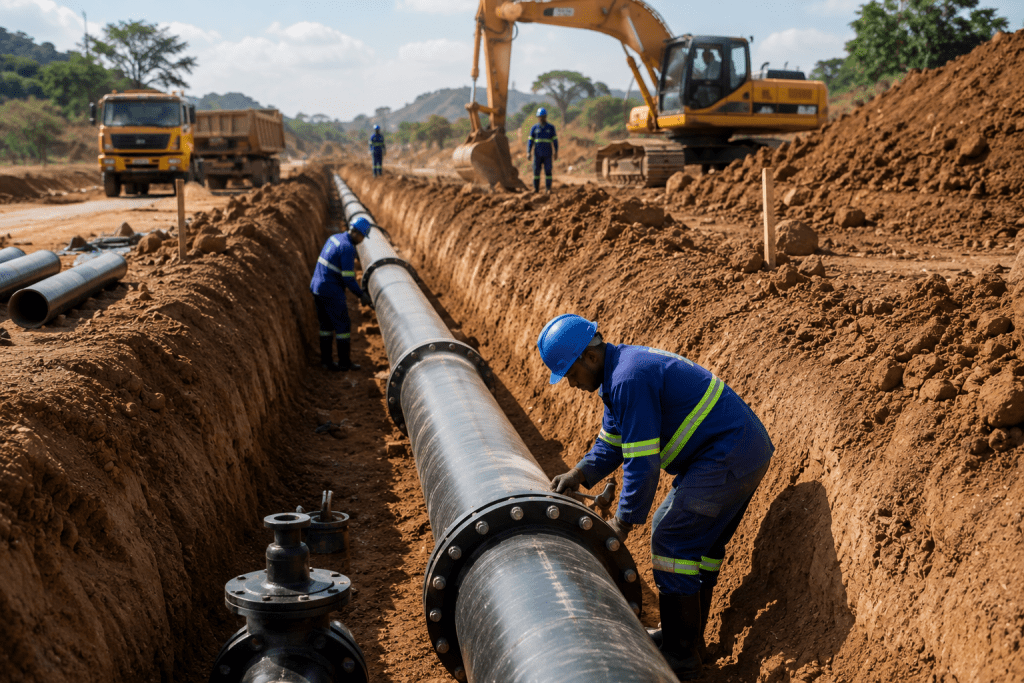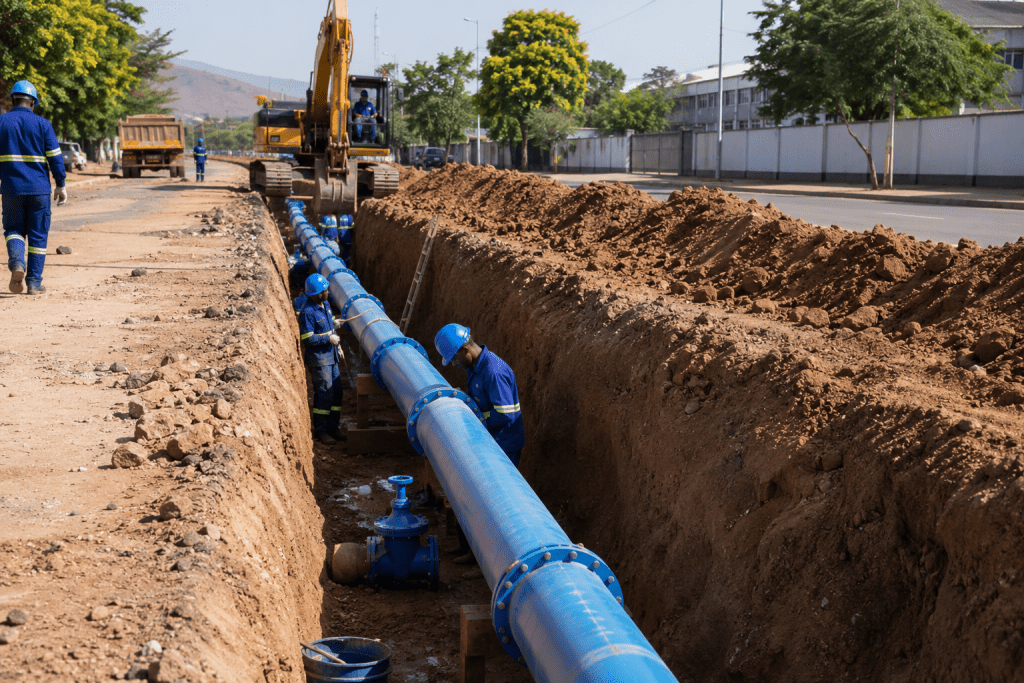
Selecting the right pipe material is one of the most important decisions in any water reticulation project. Whether the project involves a residential development, municipal water network, industrial facility, mining operation, agricultural scheme, or commercial property, the performance of the entire system depends heavily on the pipes used to distribute water.
A properly designed water reticulation network is expected to operate reliably for decades. Poor material selection can lead to leaks, excessive maintenance costs, reduced lifespan, pressure failures, and expensive repairs. On the other hand, choosing the right pipeline material can improve reliability, reduce operating costs, and provide long-term value.
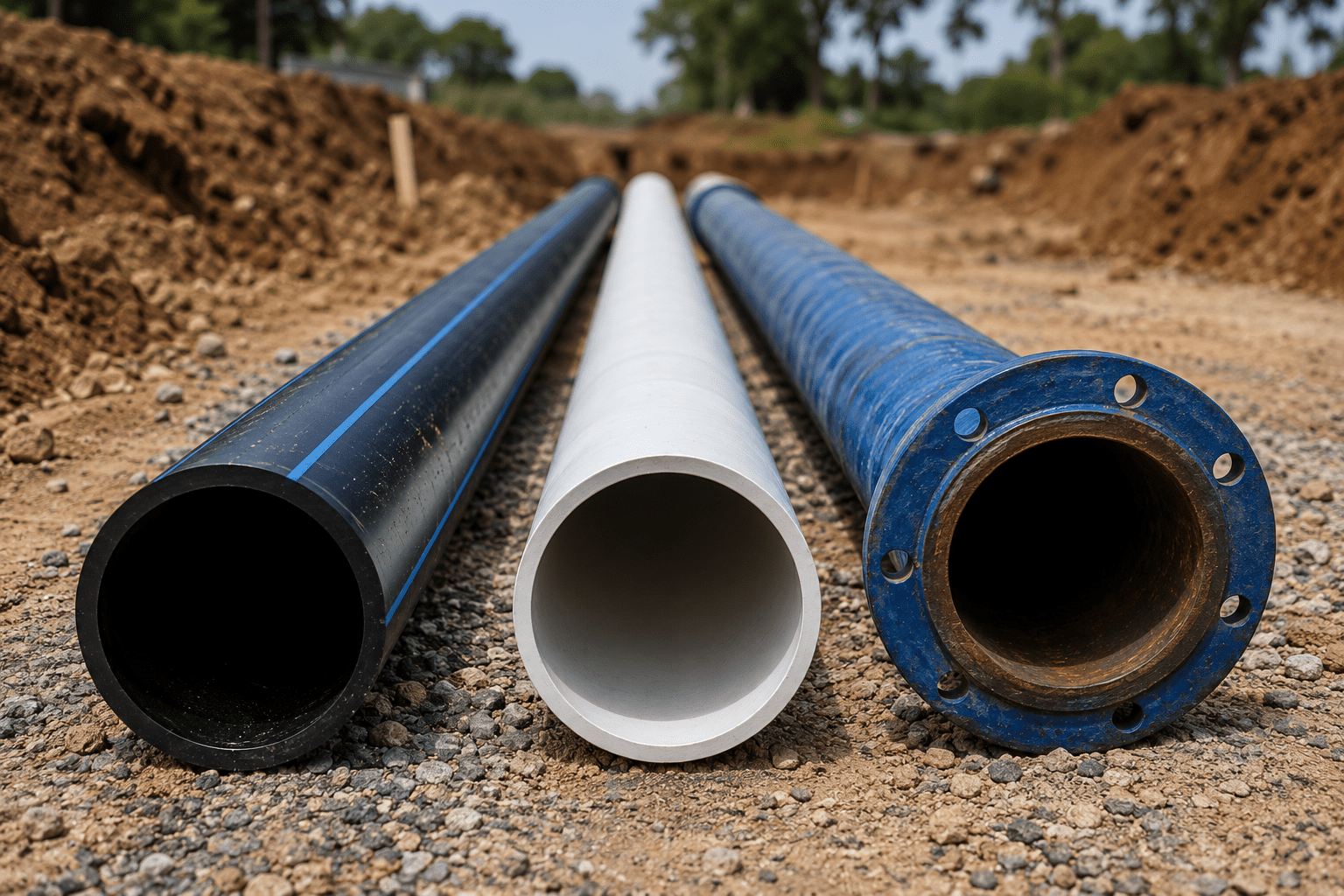
Across Zimbabwe, three of the most commonly used pipe materials for water reticulation projects are HDPE pipes, PVC pipes, and ductile iron pipes. Each material has its own strengths, limitations, and ideal applications.
There is no single pipe that is automatically the best for every project. The most suitable choice depends on factors such as pressure requirements, installation conditions, project size, expected lifespan, maintenance requirements, and available budget.
Understanding the differences between HDPE, PVC, and ductile iron pipes helps project owners make informed decisions and avoid costly mistakes during the planning stage.
Request Professional Water Reticulation Services
Planning a water reticulation or pipeline project in Zimbabwe? Contact our team for professional advice and a detailed quotation.
Why Pipe Selection Matters
Many people focus primarily on pipeline installation costs when planning a project. While cost is important, pipe selection should never be based solely on the cheapest material available.
Water pipelines are long-term infrastructure assets. Once installed, they are expected to serve communities, businesses, and facilities for many years. Replacing underground pipelines can be expensive and disruptive, making the initial material choice especially important.
Factors such as ground conditions, water pressure, environmental exposure, maintenance accessibility, and future expansion plans all influence the suitability of different pipe materials.
The best pipeline material is often the one that provides the greatest long-term value rather than the lowest upfront cost.
What Are HDPE Pipes?
HDPE stands for High-Density Polyethylene. These pipes have become increasingly popular in Zimbabwe and throughout Africa because of their flexibility, durability, and resistance to corrosion.
Unlike rigid pipe materials, HDPE pipes can accommodate minor ground movement without cracking. This characteristic makes them particularly useful in areas where soil conditions may change over time.
One of the most significant advantages of HDPE is its welded jointing system. Individual pipe sections are fused together using specialised equipment, creating joints that are often as strong as the pipe itself. This significantly reduces the risk of leakage compared to some traditional connection methods.
HDPE pipes are also resistant to many chemicals and environmental conditions that can affect other materials.
Because of these advantages, HDPE is widely used for municipal water reticulation, mining infrastructure, industrial water systems, agricultural projects, and bulk water supply pipelines.
Advantages of HDPE Pipes
HDPE offers several benefits that make it attractive for modern water infrastructure projects.
The material is highly flexible, allowing it to adapt to varying ground conditions. This flexibility reduces the likelihood of cracking or structural failure when minor ground movement occurs.
HDPE is also highly resistant to corrosion. Unlike metallic pipes, it does not rust or deteriorate due to moisture exposure.
Its smooth internal surface helps maintain efficient water flow while reducing friction losses within the system.
Many project owners also appreciate the long service life associated with HDPE pipelines. When installed correctly, these systems can provide reliable performance for decades.
The lightweight nature of HDPE can simplify transportation, handling, and installation compared to heavier pipeline materials.
Limitations of HDPE Pipes
Although HDPE provides many advantages, it is not always the ideal solution for every project.
The specialised equipment required for fusion welding can increase installation complexity. Proper jointing procedures must be followed to ensure long-term reliability.
HDPE pipes can also experience greater expansion and contraction compared to some alternative materials when exposed to significant temperature changes.
For certain high-pressure applications or projects requiring exceptional structural rigidity, engineers may consider alternative materials depending on project requirements.
These limitations do not necessarily make HDPE unsuitable, but they highlight the importance of selecting materials based on project-specific conditions rather than general popularity.
What Are PVC Pipes?
PVC, or Polyvinyl Chloride, remains one of the most widely used pipeline materials in water reticulation systems.
PVC pipes are known for their affordability, ease of installation, and widespread availability. They have been used successfully in water infrastructure projects for many years and continue to play an important role in residential, commercial, and municipal developments.
The material is lightweight, making transportation and handling relatively straightforward. PVC pipes also resist corrosion and chemical degradation under normal operating conditions.
Because of their cost-effectiveness, PVC pipelines are frequently used in residential developments, small municipal projects, irrigation systems, and commercial water distribution networks.
For many projects, PVC provides an effective balance between affordability and performance.
Advantages of PVC Pipes
PVC offers several practical benefits that contribute to its continued popularity.
One of the most significant advantages is cost. PVC pipes are generally more affordable than ductile iron and can often be less expensive than certain HDPE installations depending on project requirements.
The material is lightweight and easy to install, which can reduce labour requirements and construction time.
PVC also offers good hydraulic performance due to its smooth internal surface. This helps maintain efficient water flow while reducing energy losses within the system.
Corrosion resistance is another major advantage. Unlike metallic pipes, PVC does not rust when exposed to water.
These characteristics make PVC an attractive option for many standard water reticulation applications.
Limitations of PVC Pipes
Despite its advantages, PVC has certain limitations that should be considered during project planning.
The material is less flexible than HDPE and can be more susceptible to damage if significant ground movement occurs. Improper installation or unstable soil conditions may increase the risk of cracking.
PVC joints can also become potential leak points if installation standards are not maintained.
While PVC performs well in many applications, it may not always be the preferred choice for highly demanding industrial, mining, or large-scale municipal projects where exceptional durability is required.
Proper engineering evaluation remains essential when selecting PVC for long-term infrastructure projects.
Discuss Your Pipeline Material Options
Not sure which pipe material is best for your project? Our team can help assess your requirements and recommend the most suitable solution.
What Are Ductile Iron Pipes?
Ductile iron pipes are among the strongest and most durable pipeline materials used in water infrastructure.
Manufactured from specially treated iron, these pipes provide exceptional structural strength and can withstand demanding operating conditions. They have been used extensively in municipal water systems around the world for decades.
Ductile iron is particularly suited to applications involving high pressures, heavy traffic loads, and challenging installation environments.
Many municipalities continue to rely on ductile iron for major water distribution networks because of its proven performance and long service history.
Although installation costs may be higher than some alternative materials, many project owners view ductile iron as a long-term investment in infrastructure reliability.
Advantages of Ductile Iron Pipes
The greatest advantage of ductile iron is its strength.
These pipes can tolerate high internal pressures while resisting external loading from traffic, soil, and other environmental factors. This makes them particularly useful in urban infrastructure projects where pipelines may be subjected to significant stresses.
Ductile iron also offers excellent durability and can achieve very long service lives when properly installed and maintained.
Because of its structural strength, the material is often selected for critical municipal infrastructure where reliability is a top priority.
Many engineers consider ductile iron one of the most robust options available for major water distribution systems.
Limitations of Ductile Iron Pipes
The primary limitation of ductile iron is cost.
Material costs are generally higher than PVC and often higher than HDPE. Installation costs may also increase due to the weight of the pipe and the equipment required for handling and placement.
Although modern protective coatings help reduce corrosion risks, metallic pipes may still require additional protection in certain environmental conditions.
Transportation and logistics can also become more expensive due to the weight of the material.
For smaller projects, these additional costs may influence the decision-making process.
Which Pipe Material Is Best for Water Reticulation?
The answer depends entirely on the project requirements.
HDPE is often preferred for projects where flexibility, leak resistance, and corrosion resistance are priorities. It performs particularly well in mining, industrial, agricultural, and municipal applications where ground conditions may vary.
PVC remains a strong option for many residential, commercial, and municipal projects where cost efficiency and ease of installation are important considerations.
Ductile iron is frequently selected for major municipal infrastructure projects requiring exceptional strength, durability, and long-term reliability.
Rather than asking which material is universally best, a more useful question is which material is best for a specific project.
The answer depends on engineering requirements, budget considerations, operating conditions, and long-term infrastructure objectives.
Factors to Consider Before Choosing a Pipe Material
Several important factors should be evaluated before selecting a pipeline material:
- Project budget and available funding.
- Water pressure requirements.
- Ground conditions and soil stability.
- Installation environment.
- Maintenance requirements.
- Expected service life.
- Future expansion plans.
Carefully assessing these factors helps ensure the chosen material supports both current and future project needs.
This decision should ideally be made during the design stage when engineers can evaluate all technical and operational requirements.
Water Reticulation Projects Across Zimbabwe
Water reticulation infrastructure continues to play a critical role in residential developments, commercial facilities, industrial projects, municipal networks, agricultural schemes, and mining operations throughout Zimbabwe.
As infrastructure investment continues to grow, selecting appropriate pipeline materials remains essential for achieving reliable and cost-effective water distribution systems.
Projects are undertaken across Harare, Bulawayo, Mutare, Gweru, Masvingo, Kwekwe, Chinhoyi, Marondera, and other developing regions where dependable water infrastructure supports economic growth and community development.
Final Thoughts
HDPE, PVC, and ductile iron pipes all have important roles within modern water reticulation systems. Each material offers unique advantages and is suited to specific applications.
HDPE provides flexibility, leak resistance, and corrosion protection. PVC offers affordability and ease of installation. Ductile iron delivers exceptional strength and long-term durability.
The best pipe material for a water reticulation project depends on the specific requirements of the development, operating conditions, budget, and long-term infrastructure goals.
By evaluating project needs carefully and seeking professional guidance during the planning stage, developers, municipalities, businesses, and property owners can select a pipeline solution that delivers reliable performance for many years to come.
Request a Water Reticulation Quote
Whether you are planning a residential development, municipal network, industrial facility, or commercial project, contact our team for professional water reticulation and pipeline construction services across Zimbabwe.